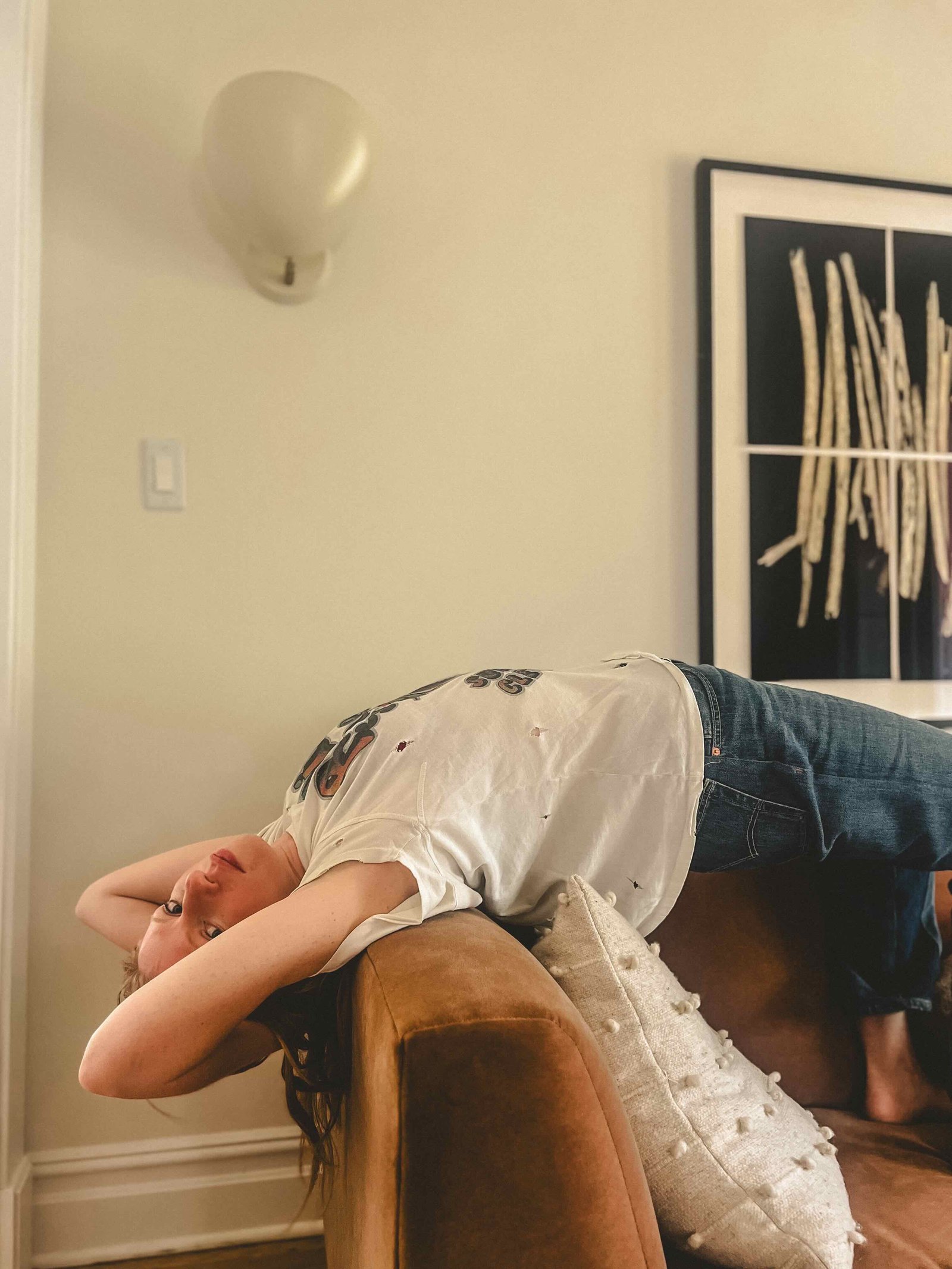
Kathryn Norris teaches self-myofascial release, yin yoga, and Pilates in Chicago studios, leads a small group online morning Pilates program, and sees 1:1 clients through her practice, Ceres Movement. All of this through a nervous-system supportive lens unique to her training as a yoga therapist and somatic practitioner.
It's my private practice. I work with 1:1 clients and small groups to support health through yoga therapy and somatic practice. I started teaching because I loved yin yoga — and the cascade of curiosity and learning it opened in me. The profound growth. My exploration and training took shape following my interest, it was non-linear but everything builds upon and informs everything else — yoga therapy, Pilates, somatic movement and practice, the subtle body, functional movement. One thing kept leading to another and at some point I wanted to share it.
I'm continuously monitoring the room. The energy, the activity, the arc — where we are in the class relative to the experience everyone is having. In a yin class that might be very inward and still. In Pilates it's a different type of mindful movement — I love to draw on nervous system science and motor learning to support self-agency and awareness.
I'm thinking about moving around the hip mandala — the myofascial groups of the outer hip, the glutes and IT band, the hamstrings, the inner thigh and groin, the hip flexors, the quadriceps. I'm thinking about the movements of the spine. Making sure we're addressing the whole body, and the nervous system, and the subtle body. The whole person. I'm calibrating and recalibrating the whole time — inviting people to be curious, to explore, to notice what feels nourishing and choose that.
I miscount reps sometimes. I call left when I mean right. That doesn't make or break anything. I'm interested in coaxing an audible exhale or unexpected laughter, finding humanity together, feeling good, feeling accomplished.
It's the application of the teachings and practices of yoga to support health and well-being — clinically, intentionally, for a specific person. Not a yoga class with modifications. Something much more individual than that.
Practically, what that means is: lifestyle shifts, movement that restores ease and creates vibrancy, a fresh perspective or framing when someone is stuck. Being an advocate. Sharing my knowledge and research so we can co-create anchors and rhythms that actually cultivate health. And health, to me, is presence. It's connection with oneself and those around us. Living in the present, engaged, with great joy and ease.
But yoga therapy is also a lens I bring into every class I teach, not just 1:1 sessions. It's an attunement to the individual within the group — and also to what the group itself generates. There's a coherence that emerges when people practice together, an exchange that can profoundly shape the experience in ways a solo practice can't. The group is doing something real.
What I love about working this way is that yoga gives me two languages simultaneously. I can talk about what the research shows about loading the connective tissue — how graded mechanical exposure supports fascial resilience — and I can talk about the same thing as prana moving through the nadis. Both are true. They're not competing. They're two lenses on the same reality, and depending on what someone needs in that moment, one might land more than the other. I don't have to choose.
Within a class or a session, I'm all in. I'm lit up by what we're doing together. I'm so profoundly grateful for the time, the trust, and the collaboration that people bring when they show up.
People who want to create change, have tried other things, and are genuinely curious about what a fresh perspective might shift. A lot of my 1:1 clients have been students in my group classes first. They've seen how I work. They know something about my depth and my approach before we ever sit down together. Others are word of mouth referrals. I haven't figured out how to use the internet to my advantage yet.
I think what draws people in is that I'm genuinely interested in knowing them. I appreciate their presence. And I'm open about not always knowing — that matters to people, I think. It signals that we're actually going to pay attention to what's happening, rather than apply a protocol.
Addition, not restriction. Restriction rarely feels nourishing. It rarely sticks.
What I'm actually doing with clients is helping them find the anchors that nourish them — and develop the discernment to notice what's working and what needs work. That takes time. It's a kind of learning. And then there's the sovereignty part: the capacity to choose to return to those anchors when life gets full, when things get hard. Not because you have to. Because you know what they give you.
That's what I'm working toward with people. A rhythm of care worth continuing.
Gardening. We moved to a big old Victorian down the street from the lake, and we have a yard. My husband and I turned neglected beds and crabgrass into gardens — even the parkway. Perennials, largely natives, but also roses, hydrangeas, Japanese anemones, and Daucus carota 'Dara,' which looks like Queen Anne's lace but in shades of rose and purple. I love planting, weeding, tending. Being outside. Seeing what it makes and sharing it with my family, with our neighbors.
Though honestly it probably does have something to do with all of this. The name Ceres isn't accidental.
Currently
Begin with a conversation.
A free 15-minute consultation to find the right fit — 1:1 yoga therapy, somatic coaching, Morning Mat, or a studio class that fits your week.